Road Use Regulations Round Up

This round up features some action in Canada, Wisconsin, Colorado and some other states as well as signs of growing interest in medium speed vehicle regulations.

Grand Chute, WI – Town asking state for help regarding the use of NEVs on some of the many roads under state jurisdiction that criss-cross the city.

Loveland, COHouse Bill 1026, which would allow neighborhood electric vehicles on public highways, passed the Judiciary Committee and will be going to a House vote.

North Vancouver, Canada – City council rejects staff recommendations to wait for additional LSV safety standards before allowing vehicles on roads.

Sedona, AZ – Public transportation commission recommends feasibility study to look at NEVs as a public transportation option.

British Columbia, Canada – Motor vehicle regulations amended to allow incidental use of roads by utility vehicles during their normal off-road use.

Kennebunk, ME – ZAP Xebra three-wheeled truck doesn’t pass registration as a motorcycle and therefore cannot be legally driven. Amendment to address issue in process.

Flower Mound, TX – Transportation commission is urged to look at LSV regulations in anticipation of increased usage of the vehicles.

Denver, CO – State Senate bill aims to create uniform road use regulations for LSVs

South Daytona, FL – After a favorable feasibility study, city officials are moving ahead on allowing golf carts to be used on city streets.

Manitoba, Canada – Manitoba province is looking at enacting similar legislation as Ontario and Quebec to allow LSVs on public roads.

Merrill, WI – City officials are drafting legislation to allow NEVs on public roads with speed limits of 35mph or less

Medium Speed Vehicle Regulations – At the end of February nine states were considering medium speed vehicle laws: Hawaii, New Mexico, Kentucky, New York, Oregon, South Carolina, Georgia and Colorado. Speed limits proposed ranged from 35mph to 50 mph with most at 45 mph. Five states who have already adopted MSEV laws include Washington, Montana, Minnesota, Oklahoma, and Tennessee.

Connecticut – Some State Representatives are pushing to legalize NEVs

BG Automotive Shows Off Prototype Electric Vehicle

BG Automotive C100 Prototype               Photo Credit:  Clifford Atiyeh & Boston Globe

BG Automotive C100 Prototype Photos: Clifford Atiyeh/Boston Globe

BG Automotive recently showed a prototype of their C100 NEV to Massachusetts officials in hopes of generating financial support for production facilities in the state. They are also looking to obtain funding from the US Department of Energy.

The C100 features a 48 volt, 18 hp electric motor powered by eight lead acid batteries and has a range of 60-80 miles according to the company. Except for the controller, motor and batteries which are produced in the US, the rest of the vehicle’s parts are produced in China. Price range will be $16,000 to $18,000.

A Boston Globe reporter took the vehicle for a parking lot test drive and had a mixed review.

Pros:

  • Decent economy car
  • Good seat position
  • Some nice features

Cons:

  • Noise
  • Slow acceleration
  • Poor braking

The company still expects to make a May/June 2009 launch date despite not having any facilities in place. Learn more: Boston Globe Article

Update 3/23:?? The article is updated to note that the vehicle is actually the Chang’an Ben Ben or Chana Benni produced in China.

Aurora, IL: STOV Market Segment Example

NEV Replacing Full-size Vehicle

NEV Replacing Full-size Vehicle

The parks and recreation department in Aurora, IL has just purchased two NEVs from GEM to replace full-sized vehicles.?? The vehicles are being used for maintenance in a park and a zoo. Learn more

Comment: This is an excellent example of where a full-sized vehicle is overkill but a utility vehicle can be highly efficient performing the necessary tasks.?? In this case it also an example of market segments where end-users (often parks departments) are switching from gas-powered to and electric powered vehicles. mcesare

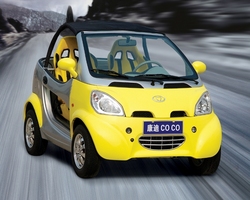
Electric Kandi COCO LSVs Hit The Market

Electric Kandi COCO a new LSV for the US market

Electric Kandi COCO a new LSV for the US market

Solus International, the exclusive importer for electric Kandi COCO vehicles, reports that 100 vehicles have been imported for the US market. The marketing drive was kicked off at the 2009 NADA show in New Orleans in early January. The LSVs have a range of 50-60 miles and operates on a DC motor with a 72 volt system using lead acid batteries. The MSRP for the vehicle is $12,995.

The vehicles are manufactured in China by the Kandi Group which also produces ATVs/Quads, go-karts, UTVs, electric scooters and other vehicles. Most of these other vehicles are gas powered including a gas powered version of the COCO. Franklin Motorsports is a regional distributor for the LSV and powersports vehicles. Learn more

Comment: While in previous years we have seen LSVs manufacturers looking overseas to source parts or an entire vehicle minus the electric drive system, the latest trend has more overseas manufacturers trying to export their own complete vehicles to the US market. They are also adding to the list of LSVs that are available on the US market which, while still dominated by GEM, is becoming more competitive and seeing more marketing dollars being put into the category as a whole. It will be interesting to see how well these imports are received in the market. mcesare

Baoya Vehicles Sold Through Dealership In Knoxville, TN

Second Chance Finance Auto Sales, soon to be called Wildfire Motors of Knoxville is selling a Chinese manufactured LSV supplied by Wildfire Motors of Steubenville, OH.?? The models, WF120-2C and WF120-4C, look similar to the Baoya electric vehicles produced by Shandong Baoya Vehicle Company of China. See earlier post

Wildfire Motors LSV Model WF120-2C

The vehicle has a 8.5 kilowatt, 120 volt, AC motor which runs on 10 105Amp maintenance free sealed lead acid batteries. ?? The top speed is set for 25 mph but can be programmed for speeds up to 50 mph.?? At a speed of 30mph the vehicle has a range of 70 miles and can be charged using a typical home outlet.???? The vehicle comes in two and four passenger versions as well as a utility truck version with MSRPs ranging from $14,618 and $15,325. There is also a 72 volt power system option available. Learn more about the dealer and Wildfire Motors

Wheego Starts Taking Orders for the Whip LSV

Wheego announced yesterday that they have begun taking orders for their Wheego Whip electric vehicle.?? The LSV is expected to ship in May of this year.?? Last week’s announcement regarding the launch of their dealership network generated a strong response from potential vehicle buyers as well.?? According to the company’s press release:

The Wheego Whip is a fully loaded two-passenger automobile with fit, finish and features that compete with any other subcompact car on the market. Remote keyless entry, air conditioning and an mp3 stereo system are standard equipment on the Whip. It retails for under $19,000, and it only costs about 3 cents per mile to operate. There is also a 10% Federal Tax credit on the purchase price of the car as a Low Speed Vehicle in 2009.

Wheego is offering a number of incentives related to the launch of the Whip including special programs for upgrading the vehicles when Lithium ion battery packs or full speed versions of the vehicle are available, as well as cash rebates for referring other customers.?? Learn more

Shandong Baoya Vehicle Company Claims Impressive US Sales

BaoYa Electric Vehicle From China

BaoYa Electric Vehicle From China

Shandong Baoya Vehicle Company of China recently reported impressive US sales for their BaoYa vehicle. The company claims 500 vehicles were sold in 2008 and that orders for 2009 have already reached 4,800. The vehicle has a top speed of 50 mph (limited to 25 mph as a low speed vehicle) and a range of 90 miles according to the company. The vehicle is priced in China at $4,500 to $5,000.

Comment: I am skeptical about these sales figures for both 2008 and 2009. The 2008 figures would mean they outsold more well known LSVs like ZENN and Tomberlin and the 2009 figure would put them on par with GEM sales, all while going largely unnoticed in the market. The performance characteristics at that price point also seem optimistic.


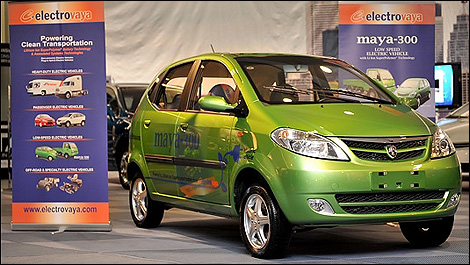
Electrovaya’s Maya 300 To Be First Li-Ion Powered LSV In North America

Electrovayas Lithium-Ion Powered Maya 300

Electrovaya's Lithium-Ion Powered Maya 300

If all goes according to plan the Maya 300 will be available this summer in the US and Canada.?? The LSV will be available with either a 12 KW or 18 KW Lithium ion battery pack, which will give the vehicle a range of 80 km or 120km respectively.?? Produced by Electrovaya, the LSV will be priced around $20,000 and will be assembled in either Mississauga, Ontario, or Malta, NY,?? the final decision is yet to be made.

The Maya 300 is based on the Chana Benni car which is manufactured by Chana International Corporation in Chongqing (province of Sichuan) with styling by Bertrone of Italy.?? Learn more

Chrysler Creates Separate Subsidiary for Peapod

Peapod From Newly Formed Peapod Mobility, Llc

Peapod From Newly Formed Peapod Mobility, LLC

Chrysler recently created a separate subsidiary, Peapod Mobility, LLC, to market the Peapod, which had been under the GEM brand. The new company is headed up by Chrysler “brand guru” Peter Arnell who helped design the Peapod. The company is targeting the 20 something segment with the vehicle. Arnell recently told Brandweek,

You know how the Beetle was the vehicle of choice for the whole ’60s, the hippie revolution and everything? We’re hoping that this becomes the new-wave car for the younger set as well as addressing mom and her needs with her kids.

The company expects to deliver the first Peapod. a four-seater, in September 2009 followed by a two-seater later in the year and a utility vehicle in the Spring of 2010. Learn more

Comment: If they do produce a utility vehicle what will that mean for GEM which sells a large number of vehicles configured as utility vehicles. It seems like it would put the companies in direct competition. The other question is whether or not NEVs with their limited mobility will appeal to a younger and presumably more mobile market segment.

NEVs Helped By Stimulus Bill

The tax credit for NEVs made it into the final stimulus bill recently signed by Obama.?? The tax credit is for 10% of the purchase price of the vehicle with a?? maximum credit of $2,500.?? Three wheel vehicles like those produced by ZAP will also be eligible.

The bill also includes $300 million for federal fleet purchases of hybrid and electric vehicles which could help NEV manufacturers. Vehicles must be replaced on a one-to-one basis, and to remove a functioning government vehicle, the hybrid or electric replacement must have an improved fuel economy at least 10-percent greater than the original. Learn more